Planning a paramotor flight involves more than knowing how much fuel is in the tank. Your total flying weight, wing loading, trim setting, airspeed, engine fuel consumption, and wind conditions all affect how far you can travel.
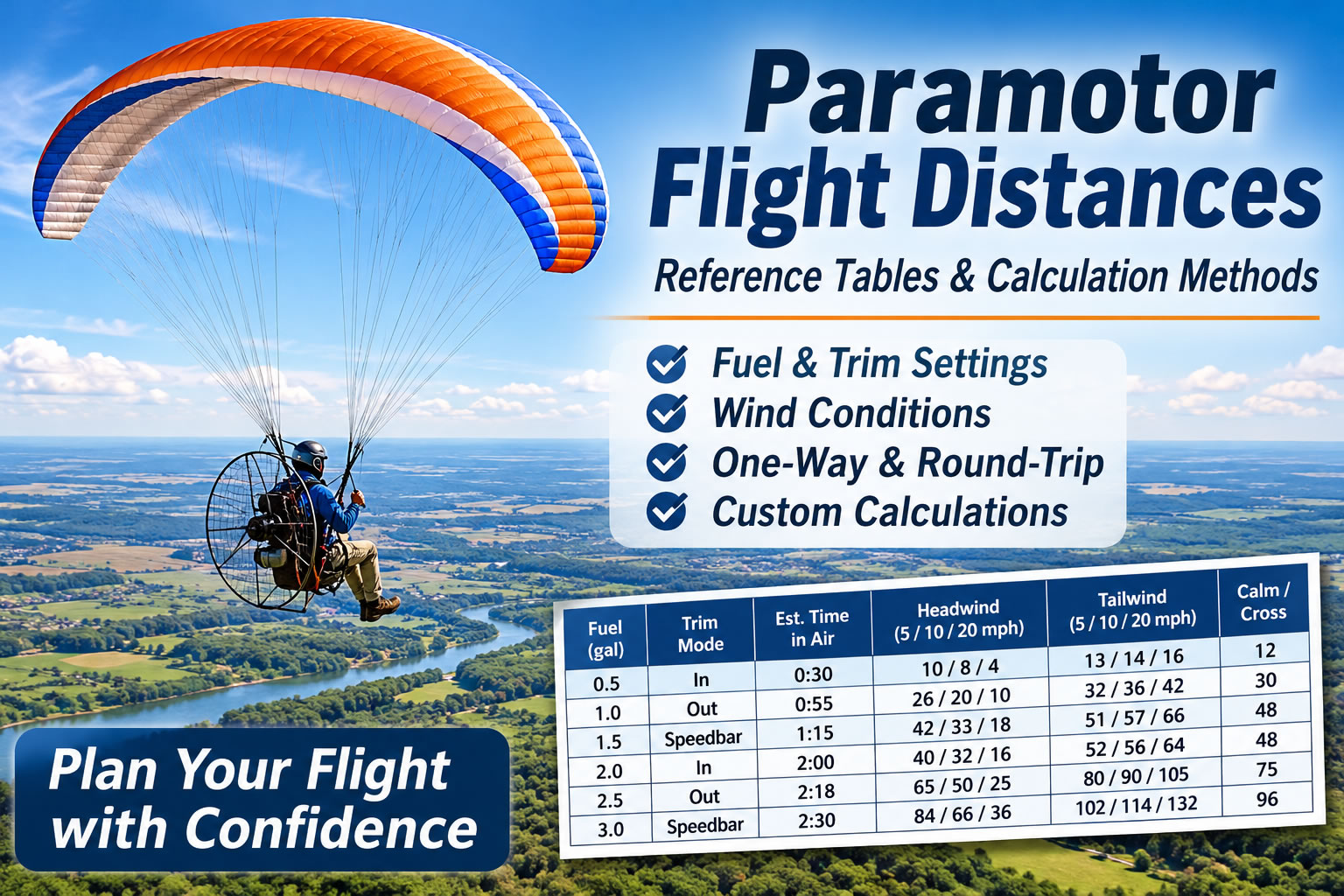
I created the downloadable reference tables below to make these calculations easier. They estimate one-way and round-trip distances for different fuel quantities, trim settings, and wind conditions. The calculations are based on a particular pilot and equipment combination, so your own numbers may be different.
Download the Flight Planning Reference Tables (Word document)
Start With Your Total Flying Weight
Your total flying weight is important because it determines wing loading. Wing loading affects the wing's operating characteristics and is one of the inputs needed to select an appropriate airspeed for your equipment.
Include everything that will be flying with you:
- Pilot, including clothing and helmet
- Paramotor and engine
- Wing
- Fuel carried at takeoff
- Harness, reserve, instruments, and other equipment not already included in the paramotor weight
Total Flying Weight = Pilot Weight + Motor Weight + Wing Weight + Equipment Weight + Fuel Weight
Be careful not to count equipment twice. For example, if a published paramotor weight already includes its harness or other components, do not add those items again.
Calculate Wing Loading
Once you know your total flying weight, calculate wing loading using the wing's flat area from its manufacturer specifications:
Wing Loading = Total Flying Weight ÷ Wing Flat Area
Use consistent units. If your weight is in kilograms and your wing area is in square meters, the result is kg/m². If your weight is in pounds and wing area is in square feet, the result is lb/ft².
Here is an example using the equipment assumptions behind my reference tables:
- Pilot: 160 lbs (72.6 kg)
- Motor: Top 80 Miniplane, approximately 20.55 kg dry
- Wing: Mac Para Charger, approximately 5.6 kg
- Wing flat area: approximately 25.43 m²
- Fuel weight: approximately 2.78 kg per US gallon
These figures provide a baseline. Add any additional equipment weight that is not already included in the motor or pilot weights.
For example, with 2.3 gallons of fuel:
Total Flying Weight = 72.6 + 20.55 + 5.6 + (2.3 × 2.78)
Total Flying Weight = approximately 105.1 kg
Wing Loading = 105.1 ÷ 25.43
Wing Loading = approximately 4.13 kg/m²
This is the starting point for selecting the correct performance data for your wing.
Why Fuel Quantity Changes Wing Loading
Fuel is part of your flying weight. More fuel means more weight at takeoff, and as fuel is consumed, your total weight and wing loading decrease.
Using the equipment assumptions above, the approximate loading at different fuel quantities is:
| Fuel | Fuel Weight | Total Weight | Wing Loading |
|---|---|---|---|
| 0.5 gal | 1.4 kg | 100.1 kg | 3.94 kg/m² |
| 1.0 gal | 2.8 kg | 101.5 kg | 3.99 kg/m² |
| 1.5 gal | 4.2 kg | 102.9 kg | 4.05 kg/m² |
| 2.0 gal | 5.6 kg | 104.3 kg | 4.10 kg/m² |
| 2.3 gal | 6.4 kg | 105.1 kg | 4.13 kg/m² |
| 2.5 gal | 7.0 kg | 105.7 kg | 4.16 kg/m² |
| 3.0 gal | 8.3 kg | 107.1 kg | 4.21 kg/m² |
These are baseline estimates, not a complete weighing of every accessory. Use your actual equipment weights to make the table accurate for your setup.
Use Wing Loading to Select Airspeed
This is where the wing-loading calculation becomes an actual input to the flight-planning process. Do not simply assume that every pilot using the same wing will have the same airspeed.
First, determine the wing loading for the fuel quantity you intend to carry. Then use the wing manufacturer's performance information to find the appropriate airspeed for that loading and your selected trim configuration.
If the manufacturer provides speed data at several wing loadings, you can interpolate between the closest values to estimate the speed at your calculated loading.
For example, if manufacturer data provides speeds at 4.0 and 4.5 kg/m², and your calculated loading is 4.13 kg/m², you can interpolate between those two data points. The resulting speed is an estimate based on the manufacturer's performance data, not a universal weight-to-speed formula.
If the manufacturer does not provide speed data at different loadings, use measured flight data for your own wing and loading. GPS readings are ground speed, not airspeed, so account for the wind when establishing an airspeed estimate.
The original reference table uses these approximate trim-speed ranges as its starting assumptions:
| Trim Setting | Assumed Airspeed |
|---|---|
| In | 22–24 mph |
| Out | 29–31 mph |
| Speedbar | 34–37 mph |
These are the speed assumptions used as a starting point for the original calculations. They should not be interpreted as guaranteed speeds at every loading. For a different pilot or fuel quantity, recalculate wing loading and use the corresponding manufacturer or measured performance data before generating a new table.
A square-root relationship between wing loading and speed is sometimes used as a simplified aerodynamic approximation under specific conditions. However, it is not a dependable universal method for predicting paramotor cruising speed across different wings, trim settings, or operating conditions. Use actual performance data whenever possible.
Estimate Engine Fuel Consumption
Fuel consumption determines how long you can remain in the air. Use the engine manufacturer's published fuel-consumption information when it applies to your engine's operating conditions.
Convert liters per hour to US gallons per hour using:
Gallons per Hour = Liters per Hour ÷ 3.78541
The original reference-table calculations are consistent with the following fuel-consumption assumptions:
| Trim Setting | Estimated Fuel Consumption |
|---|---|
| In | 1.0 gal/hr |
| Out | 1.1 gal/hr |
| Speedbar | 1.2 gal/hr |
These rates were inferred from the original table's fuel quantities and estimated flight times. They are the assumptions that reproduce those time calculations; they should not be mistaken for verified manufacturer specifications for every Top 80 installation.
Actual consumption varies with engine RPM, propeller, carburetion, altitude, temperature, engine condition, and operating load. A heavier aircraft may require more engine power, but there is no reliable universal formula that converts a percentage increase in weight into the same percentage increase in fuel consumption.
To make your own table more accurate, measure fuel consumption during representative flights using your own equipment and typical flying technique:
- Start with a known quantity of fuel.
- Fly for a measured amount of time under representative conditions.
- Measure how much fuel was consumed.
- Divide fuel consumed by flight time to calculate gallons per hour.
- Repeat over multiple flights to establish a more dependable average.
Fuel Consumption = Fuel Consumed ÷ Flight Time
Use separate consumption estimates for different trim or power settings only when you have data to support them. If you do not have measured data, treat the rates as planning assumptions.
Account for Fuel Reserve
Never plan to use every drop of fuel in your tank. Subtract your intended reserve before calculating the flight time available for the planned route.
Usable Fuel = Fuel Carried − Fuel Reserve
Then calculate available flight time:
Available Flight Time = Usable Fuel ÷ Fuel Consumption per Hour
For example, with 2.3 gallons carried, a 0.5-gallon reserve, and a consumption rate of 1.0 gallon per hour:
(2.3 − 0.5) ÷ 1.0 = 1.8 hours of planned flight time
The reserve is not fuel available for the planned distance. Choose a reserve appropriate to your equipment, conditions, and operating practices. Do not assume that the original table's flight times already include a reserve: its time values are consistent with dividing the full fuel quantity by the estimated consumption rate.
Calculate Ground Speed Using Wind
Airspeed and ground speed are different. Wind can substantially change how far you travel during a given amount of flight time.
For a direct headwind or tailwind:
- Headwind: Ground Speed = Airspeed − Wind Speed
- Tailwind: Ground Speed = Airspeed + Wind Speed
For example, with an airspeed of 30 mph and a 10 mph headwind, your ground speed is approximately 20 mph. With a 10 mph tailwind, it is approximately 40 mph.
For wind at an angle, calculate the wind component along your intended route:
Along-Track Wind = Wind Speed × cos(θ)
Here, θ is the angle between the wind's direction of travel and your intended flight direction. A direct tailwind is 0 degrees, and a direct headwind is 180 degrees.
Ground Speed = Airspeed + Along-Track Wind
This simplified calculation does not account for the additional heading correction required to maintain a track in a crosswind.
Calculate One-Way Distance
Once you have the appropriate airspeed, wind component, and available flight time, calculate one-way distance:
One-Way Distance = Ground Speed × Available Flight Time
For example, if your airspeed is 30 mph, you have a 5 mph direct headwind, and 1.8 hours of usable flight time:
(30 − 5) × 1.8 = 45 miles
This is a theoretical distance under constant conditions. It does not account for changing wind, route deviations, takeoff and landing, or other operational considerations.
Calculate Round-Trip Distance
Round-trip planning must account for the wind in both directions. A tailwind on the outbound leg becomes a headwind on the return leg.
For a simplified round trip with a constant direct wind, the same airspeed in both directions, and equal outbound and return distances, calculate the maximum distance away from your starting point using:
Round-Trip One-Way Distance = Available Flight Time × (Airspeed² − Wind Speed²) ÷ (2 × Airspeed)
This assumes the wind is directly along the route, remains constant, and is weaker than the aircraft's airspeed. Available flight time is the total time for both legs.
For example, with an airspeed of 30 mph, a direct wind of 10 mph, and 1.8 hours of available flight time:
1.8 × (30² − 10²) ÷ (2 × 30) = 24 miles
This is approximately 24 miles away from the starting point. The total distance traveled over the complete round trip would be approximately 48 miles.
This is a simplified model, not a guarantee that you can return safely. Actual wind can change in speed and direction, and route adjustments or different airspeeds can change the result.
Build Your Own Custom Flight-Planning Table
The calculations should be connected in the following order. Each step supplies an input to the next step:
- Enter your equipment weights. Include pilot, motor, wing, additional equipment, and fuel.
- Calculate total flying weight. Recalculate this for each fuel quantity you want to include in the table.
- Calculate wing loading. Divide total flying weight by the wing's flat area.
- Select airspeed. Use manufacturer performance data or measured flight data for that wing loading and trim setting. Interpolate between manufacturer data points when appropriate.
- Enter fuel consumption. Use applicable engine data or measured fuel burn for the selected operating condition.
- Subtract fuel reserve. Do not include reserved fuel in the available flight time.
- Calculate flight time. Divide usable fuel by fuel consumption per hour.
- Apply wind corrections. Calculate the outbound and return ground speeds.
- Calculate distance. Use the one-way or round-trip equation.
This is why weight and wing loading belong in a custom flight-planning spreadsheet: they determine which performance data should be used for the particular fuel load and equipment configuration. If you change your pilot weight, wing, motor, or fuel quantity, you should recalculate loading and reassess the airspeed input rather than blindly reusing the same speed assumptions.
Fuel consumption is a separate input. Weight can influence the power required, but it should only change the fuel-burn estimate when manufacturer data or your own measurements support that adjustment.
About the Downloadable Reference Tables
The accompanying Word document contains reference tables organized by fuel quantity, trim setting, and wind conditions. The original flight-time values are consistent with estimated fuel-consumption rates of 1.0 gallon per hour in trim, 1.1 gallons per hour out, and 1.2 gallons per hour on speedbar.
The speed assumptions are approximately 22–24 mph in trim, 29–31 mph out, and 34–37 mph on speedbar. These are the starting assumptions for the original reference calculations, not guaranteed performance values for other pilots or loading conditions.
If you use a different wing, engine, propeller, pilot weight, or equipment configuration, calculate your own total flying weight and wing loading, then use performance data appropriate to that loading. Update fuel consumption using applicable manufacturer information or measured results.
You can use the equations in this article to create your own tables in Excel, Apple Numbers, or another spreadsheet application. Keep your assumptions visible so you can update them when your equipment, weight, or measured performance changes.
Download: Flight Planning Reference Tables (Word document)
A Final Note About Flight Planning
These calculations are planning aids, not a substitute for sound judgment, current weather evaluation, or conservative flight decisions. Forecast wind can differ from actual wind, conditions can change during a flight, and your engine may not consume fuel at the rate you expect.
Validate your estimates against actual flight data, maintain an appropriate fuel reserve, and plan for changing conditions. A calculated distance is only as dependable as the assumptions used to produce it.